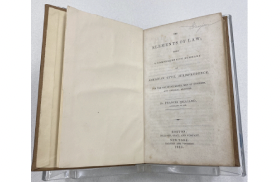
In previous posts, I have highlighted collections related to some of the authors who had an outsized impact on the early history of American lawbooks in the 19th century. Among these, Joseph Story and James Kent certainly remain central to any retelling of American legal history. Lesser known, but important for his contributions to American evidence law, was Simon Greenleaf. In this post, I want to discuss Francis Hilliard (1806-1878), a little-known 19th century author, who made great strides toward creating a library of American law.
Francis Hilliard was a lawyer and judge who made his reputation as an inveterate writer of law books. When his career began, professional-level law books in the United States were few and relatively expensive. The most productive years of Hilliard’s life, however, corresponded to a period of American history, from about 1830 to 1860, that saw a rapid increase in the number of high-quality legal treatises. (McGill and Newmyer, p. 44). Hilliard’s books are numerous and well-represented in the Law Library’s collections – the Library of Congress catalog records 33 separate entries under his authorship from the 19th century. They include the first popular account of American law, the first American treatise on torts, and accessible summaries of about a dozen other areas of law.
Born in Cambridge, Massachusetts in 1806, Hilliard was, after a fashion, raised in the book trade. His father, William Hilliard (1778-1836), was a well-known Boston publisher and bookseller. Hilliard attended Harvard and was a member of the class of 1823, 37 of whom were expelled for their role in a student riot during their senior year. In 1830, he was admitted to the bar in Suffolk County, Massachusetts. After several years, he settled in Roxbury, Massachusetts. During his career, he served as a bankruptcy judge and later as a judge of the Roxbury police. He spent a single term in the Massachusetts state legislature. An item documenting a bankruptcy case that he took part in during his law practice can be found here.
Hilliard’s legal career exposed him to many people’s financial misfortunes. It is probably no coincidence that as an author he wrote books for people with fewer means and no elite education. His first book, published by his father’s firm, was The Elements of law, being a comprehensive summary of American civil jurisprudence. For the use of students, men of business, and general readers (Boston, 1835). The book was an attempt to create an accessible introduction to the most important areas of American civil law. Hilliard recognized that the plan of the book was novel. He hoped to create a streamlined, bare-bones, and, above all, clear exposition of what his audience would find immediately useful to know. In the preface, Hilliard notes the small number of other statements of the law that existed at the time, among them Dane’s Abridgment, Kent’s Commentaries, and Blackstone’s Commentaries. While he is at pains to acknowledge their value – and they were recognized as classics in his day – he points out succinctly where his book differs:
“These are large works, usually occupying four large volumes and costing from ten to sixteen dollars; the following work is a small and cheap one, making a single octavo volume of about three hundred and fifty pages, and costing but three dollars” (italics in the original). (Hilliard, p. iii).
Who can argue with that? And despite the status of his competitors, he has no problem taking them down a bit. Dane’s work is of “great magnitude” (it was nine volumes long) and therefore cannot be called anything like a “brief and compendious abstract” made for popular use. Blackstone, he points out, “contains a large amount of matter, which in its nature is either not legal, but historical and political, or has no applicability, and even to the professional, is of little use,[sic] in this country.” Kent fills an entire volume on constitutional law and the law of nations, “both of which have more of a political than a strictly legal aspect and are therefore wholly omitted in the present work.” Kent “is also speculative, historical and discursive” which both sends him on long digressions and also leads him to omit important areas of the law. (Hilliard, iii-viii).
Elements of the Law, on the other hand, relates briefly and at a high level of generalization to a wide variety of subjects. This level of generality was in part a strategy to deal with the growing differences among the states in their courts’ application of traditional common law rules. For the most part, Hilliard draws specific examples from the laws of New York and Massachusetts to illustrate the rules he discusses. As a business proposition, Hilliard’s book was somewhat successful. It came out in a second edition in 1848 and in later editions in 1878 and 1881. Other titles soon came to occupy a similar niche in the market with more success, notably Timothy Walker’s Introduction to American law: designed as a first book for students (Philadelphia, 1837), of which the Law Library owns nine separate 19th century editions; that book was printed as late as 1905. This was to become a theme throughout Hilliard’s career. While his books had a positive reception, they were quickly superseded by the works of other authors. (Surrency, p. 44).
Hilliard continued to produce new books and new editions of his older books every several years until he died in 1878. Among these many books, one that has drawn the interest of historians is The Law of torts or private wrongs (Boston, 1859), which has been regarded as the first treatise on the subject of torts written in the English language (although the claim is questionable). As Hilliard points out in the preface to the book, until his time, the subject was never discussed in its own right but was instead covered in treatments of evidence law, nisi prius, and pleadings and practice. The focus there was typically not on the damages that might give rise to civil action but on the forms of action themselves. Hilliard’s innovation was in part based on his intuition that any discussion of remedies for damages ought in some respect to follow from the specific damages done.
Read more and see images at